
Disruption: unlocking low carbon travel
- Greg Marsden(PI),
- Lesley Murray(PI),
- Jillian Anable(CoI),
- Docherty Iain(CoI),
- James Faulconbridge(CoI),
- Helen Roby(CoI)
- University of Leeds,
- University of Aberdeen,
- University of Glasgow,
- Lancaster University,
- Open University Milton Keynes,
- University of the West of England
Research project:
Research Councils / Government Depts.
Project status
Finished
About the project
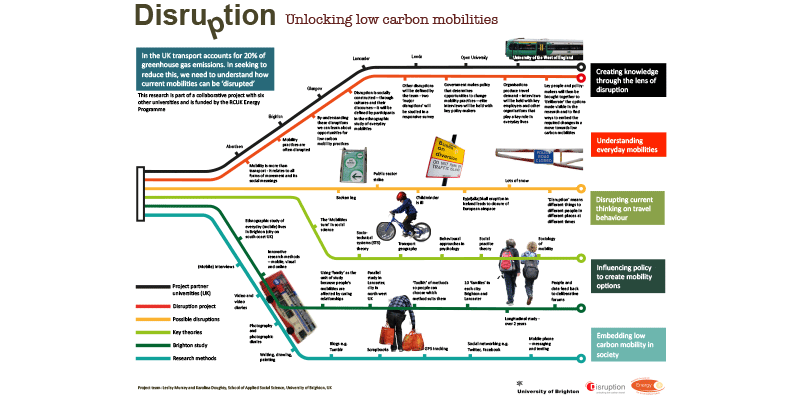
This research, which is part of a large RCUK Energy Programme funded study, examined how ‘disruption’ affects people’s everyday mobilities; mobilities in organisations that generate travel demand; and within government where policy that determines our travel opportunities is made.
The project used a range of innovative research methods to do this including capturing travel behaviour through Facebook and Twitter (project-specific accounts will be set up that participants will post to) and carrying out video-recorded mobile interviews.
It then brought together the different social actors, both ‘lay’ and ‘expert’ in a number of forums where they have the opportunity to ‘deliberate’ the different issues that will emerge throughout the research, and challenge each other about what needs to be done to capture the opportunities for change.
The project sought to establish mechanisms for embedding these changes in everyday life, in organisational practices and in social policy, so that a substantial contribution to reducing carbon emissions from transport was achieved.
The project was a collaboration with the University of Leeds (Lead), the University of Lancaster, the University of West of England, the Open University, Glasgow University, and Aberdeen University.
The aim of the project was therefore to:
> create opportunities for change that will reduce the energy use and associated greenhouse gas emissions from the transport sector
> analyse how travel practices are formed and directed by underlying societal factors, assess to what extent people’s travel behaviour is fixed and routine, and identify ways to reduce barriers to positive change
> discover how deliberative processes can effect change in mobility practices through bringing together different social actors, both 'lay' and 'expert', in a number of forums. Participants will be given the opportunity to 'deliberate' the different issues that emerge throughout the research, and challenge each other about how to capture the opportunities for change
> use insights to help reveal the kinds of changes, to transport and other policy sectors such as health, education and business that are needed to inspire and facilitate a shift to lower carbon travel.
> establish mechanisms for embedding changes in everyday life, in organisational practices and in social policy, so that a substantial contribution to reducing carbon emissions is achieved.
It was hoped that the project would reveal how disruption affects the real choices people make and teach the team about the opportunities to change travel practices at individual levels and within families; in organisations that generate travel demand and impact on individual travel decision-making; and within government policy that determines our travel opportunities is made.
Project Information
Project Type
Research Councils / Government Depts.
Project Collaborators
- University of Leeds
- University of Aberdeen
- Lancaster University
- Open University Milton Keynes
- University of the West of England
- University of Glasgow
Time Period
01/09/2011 – 31/08/2014Status
FinishedID
Funder Project Reference: EP/J00460X/1