
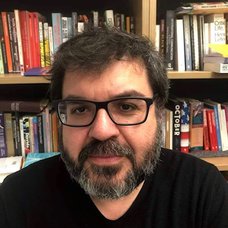
Theodore Koulouris
Dr
<p class="MsoNormal">My background is in literary and critical theory. I started my teaching career in the School of English at the University of Sussex, where I worked as a teaching fellow since the completion of my doctorate in 2005. </p>
<p class="MsoNormal">My doctoral thesis explored Virginia Woolf’s classical and pre-classical Greek influences and the ways in which she solidified what I call a ‘poetics of loss,’ by navigating the post-1850s phenomenon of British Hellenism. I reworked my DPhil thesis into a monograph entitled <em><a href="https://www.routledge.com/Hellenism-and-Loss-in-the-Work-of-Virginia-Woolf/Koulouris/p/book/9781138383951">Hellenism and Loss in the Work of Virginia Woolf</a> </em>(2011), the first book-length study of the author’s relationship with what she called her ‘dead Greeks.’ Since then, I have published further on Woolf’s relationship with Greece – see, especially, my annotated transcription of Woolf’s ‘<a href="https://www.jstor.org/stable/26932501?seq=1">Greek Notebook</a>’.</p>
<p class="MsoNormal">At Sussex, my teaching and research expertise lay mainly in post-1860s British literature and culture (especially Anglo-American and European modernisms, focusing particularly on the work of Virginia Woolf), in 20th-century constructions of sexuality (especially in representations of same-sex desire in post-1850s British literature and culture), and in genre theory (focusing especially on the theory of the novel). </p>
<p class="MsoNormal">My teaching and research interests took a decidedly material turn following the global financial crisis of 2007/8 and, especially, during the sovereign debt crisis in Greece post-2009. Since coming to the University of Brighton in 2010, I have sought to explore the ways in which the media – broadly conceptualized – perpetuate existing social, cultural and, mainly, political hegemonies whilst opening up avenues capable of accommodating a resistant socio-political imaginary predicated on egalitarianism, collective effort and justice.</p>
<p class="MsoNormal">My current research output is preoccupied with theorising what I call (the) digital Being through the thought of philosophers like Derrida, Heidegger, Stiegler <em>et al</em>. Although scholars have produced meticulous research in the wider field of digital ontology, to my knowledge no one is (yet) preoccupied with the question 'what <em>is</em> the digital Being'? Attempting to respond to this question, my research theorises (the) digital Being as <em><a href="https://www.euppublishing.com/doi/abs/10.3366/drt.2025.0374">UnBeing</a></em>, a new concept which provides me with a metalanguage for the complexity and multi-facetedness of Being in the age of digitality and AI (and what that means). </p>
Research interests
<p>I am interested in media theory and post-1850s literary history and theory (especially Virginia Woolf, Anglo-American and European modernisms), with a focus on politics, feminism, and the philosophy of media (media ethics, digital ontology, loss, mourning). I am also interested in the intellectual and socio-cultural reception of Ancient Greek texts (mainly philosophy and drama). </p>
Supervisory interests
<p>(Digital) media theory, literary theory/history (esp. Virginia Woolf, Anglophone and European modernisms, and post-1850s receptions of Hellenism); deconstruction, ethics, ontology, feminism, mourning, narrative, nationalism(s), death, loss, and memory. </p>
<p><strong> </strong></p>
<p><strong>Current PhD supervision</strong></p>
<p>Sylvie Jane Lewis (lead supervisor - live) / techne-funded / themes / topics: fairies and shyness in early modernist anglophone literature and early cinema <a href="https://research.brighton.ac.uk/en/persons/sylvie-lewis/">https://research.brighton.ac.uk/en/persons/sylvie-lewis/</a> </p>
<p> </p>
<p> </p>
Approach to teaching
<p>I endeavour to engage students by highlighting the ways in which theory – whether we talk about media, literature, politics or indeed philosophy – bears heavily on the culture in which we live and which we consume daily, as well as on the articulation and implementation of political decisions that materially influence our lives.</p>
<p>To do so, I rely heavily on twentieth-century continental theory whilst drawing on a diverse array of primary sources (especially from popular culture) and/or media texts mined from an equally diverse spectrum of media platforms: from legacy media to social media platforms and social networking sites. </p>
<p>I try to inculcate my students with a respect for the value of abstract thinking in practical, everyday life, and with a belief in the emancipatory potential of critical engagement and creative thinking. My two expectations from students are that they are a) conscientious, and b) intellectually daring.</p>
Academic qualifications
Academic Qualifications
- Higher Education Academy, UKProject: Senior Fellow (SFHEA)
- PhD, University of SussexProject: Virginia Woolf: Hellenism, Greekness and Loss
- Master, University of SussexProject: 20th Century English Literature