
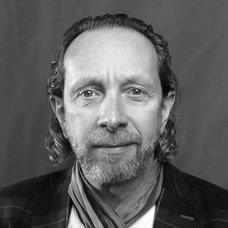
Paul Sermon
- Professor of Visual Communication, School of Art and Media
- Centre for Spatial and Social Justice
Paul Sermon is Professor of Visual Communication at the University of Brighton, his practice-based research in the field of contemporary media art centres on the creative use of telecommunication technologies.
Since the early nineteen-nineties Paul Sermon’s practice-based research in the field of contemporary media art has centred on the creative use of telecommunication technologies. Through his unique use of videoconference techniques in artistic telepresence applications he has developed a series of celebrated interactive telematic art installations that have received international acclaim.
Through a sustained research funding income Paul has continued to produce, exhibit and discuss his work extensively at an international level, exhibiting his work throughout Europe, East Asia, United States and Australia. Since 2014 he has produced six new public installation artworks, participated in two international AHRC workshops and led an AHRC funded research project, as well as presenting six new peer reviewed conference papers, published two book chapters and two new journal articles.
Paul was a nominee at the World Technology Awards 2005 and holds a number of external appointments that influence research policy. Since 2004 he has been a member of the AHRC Peer Review College, member of the NWDA funded North West Art & Design Research Group, Chair of Media Arts Network Northwest [ma-net] and advises on various international journal and conference editorials. He has led external collaborations including the AHRC funded REACT (Research Engine for Art and Creative Technology) research community and collaborative postgraduate training programme with MMU.
He studied BA Fine Art under Professor Roy Ascott at the Newport School of Fine Art from 1985 to 1988 and completed his MFA degree at the University of Reading in 1991. He then went on to be awarded the prestigious Prix Ars Electronica Golden Nica award; in the category of interactive art for the hyper media installation Think about the People now, in Linz, Austria in 1991. He produced the ISDN videoconference installation Telematic Vision as an Artist in Residence at the ZKM Center for Art and Media in Karlsruhe, Germany and received the IMF Sparkey Award from the Interactive Media Festival in Los Angeles, for the telepresent video installation Telematic Dreaming in 1994.
From 1993 to 1999 Paul Sermon worked as Dozent for Media Art at the HGB Academy of Visual Arts in Leipzig, Germany. During this time he continued to produced further interactive telematic installations for the Ars Electronica Centre in Linz, and the ZKM Media Museum in Karlsruhe. From 2000 to 2013 he worked as Professor of Creative Technology at the University of Salford and from 1997 to 2001 he was also Guest Professor for Performance and Environment at the University of Art and Industrial Design in Linz, Austria. In September 2013 he joined the University of Brighton as Professor of Visual Communication.
Research interests
Since the early nineteen-nineties my work in the field of telematic arts explores the emergence of user-determined narratives between remote participants who are brought together within shared telepresent environments. Through the use of live chroma-keying, video projection and videoconference technology these geographically divided audience participants are composited live in intimate social spaces. This is essentially how all my installation projects function, where the public participant plays an integral part within these telematic experiments, whose engagement within them makes the 'Work' and their shared experiences of them creates the 'Art'. As an artist I am both designer of the environment and instigator of the narrative, which I determine through the social and political context that I choose to play out these telematic encounters.
"Sermon aims at expanding the senses of the user, while it is obvious that the other cannot really be touched but that only swift, decisive, possibly tenderly reactive movements can experience the suggestion of touch - a moment of contemplation, as many users observed. The synaesthetical, sensual impression lets the hand and the eye fuse, and it is this effect that characterizes his work." Oliver Grau, Media Art Net
Supervisory interests
Approach to teaching
As both a professor and creative practitioner I consider my teaching to be as equally important as my practice-based research in this academic role.
I strive to teach at all levels, from first year undergraduate students to postgraduate taught masters and the supervision of PhD students. Ranging from curriculum led activities and tutorials to international projects and extracurricular activities, I strongly believe in teaching art and design through creative experiences and this practice-based research-informed teaching often directly involves my students in both the conceptual development and public exhibition of such projects.
Recent projects that demonstrate this include the Neural String Network, an interactive collaborative drawing ‘machine’ designed on the concept of a neural network, allowing my students to experience a shared creative process, using the principles of open-source and social networked communication through an analogue string system.
Played out like a surrealist ‘Exquisite Corpse’ game of consequences or as a piece of Haiku poetry, the students contributed marks, signs and signifiers to an open-content drawing, akin to the development of open-source software on neural networks. The string network consisted of five drawing table ‘nodes’. Each node was linked to the other four via pulleys and washing lines, making it possible to peg a sheet of A4 paper to a line and winch it across to any one of the other nodes. Representing the interconnected synapses and neurons of the brain the role of each participant was that of cause and effect; a single instruction initiates a series of consequences that unfold in drawings, marks and patterns that are created whilst being hoisted simultaneously across the room in quick succession.
Other collaborative student projects have included the international networking project DecodeRecode, celebrating the centenary of Alan Turing’s birth. For 24 hours, students across the globe worked live to share creative content. The students downloaded content from international partners - responded and uploaded it again. Students from all levels engaged through various networking platforms such as blogs, wikis, video conferencing and online virtual environments.
My teaching projects have also taken my students to international locations and events, including the experimental application workshop with our project Exquisite Network at Shanghai University College of Fine Arts.
I have always drawn motivation from the opportunity to develop and exhibit collaborative student projects on an international scale, inspired by my own experiences as a student of Professor Roy Ascott in the mid-1980s.
Academic qualifications
Academic Qualifications
- Project: A phenomenology of empathy and presence through telematic art practice
- Master, University of ReadingProject: Master in Fine Art
- Bachelor, University of South WalesProject: Fine Art
External positions
External Positions
- Selected subject expert for Forth EqUIP Symposium hosted by the AHRC/ESRC Social Transformation, Cultural Expressions, Cross Cultural Connections, EqUIP/AHRC/ESRC held in Gurgaon
- AHRC Creative Lab Brazil Fellow, Peoples Palace Project, Rio de Janeiro
- AHRC UnBox Fellow, National Institute of Design