
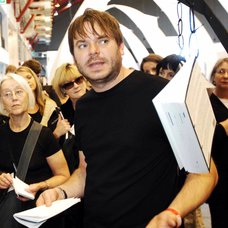
Nicholas Gant
- Principal Lecturer, School of Art and Media
- Community21 – Social and Sustainable Design Research Excellence Group
Nick is an award-winning social and sustainable designer and published academic whose research and design consultancy impacts global industrial companies, international NGOs, as well as governing bodies and civic communities in the UK and overseas. He is Co-Director of the Centre for Arts and Wellbeing and founder of the social and sustainable design research group Community21.org, which delivers collaborative research projects, consultancy and design programmes addressing global challenges with partners worldwide.
He has helped over 50 organisations develop their sustainability and social agendas through design research embodied in tangible and acclaimed products, platforms, spaces and places. He regularly delivers international workshops and presentations and has been invited to present research findings to the Department of Communities and Local Government, the Cabinet Office, the House of Lords, the Rural Commission, the European Institutes of Culture, the Department of Energy and Climate Change, the British Council, the World Crafts Council, UNESCO and the UK Deputy Prime Minister.
Nick has exhibited collaborative design research outputs at Tate Modern Exchange, the V&A Museum, the Natural History Museum, the Hayward Gallery and the Crafts Council Gallery in London, as well as internationally across the US, Europe, Asia and Australia.
He has published in leading journals and research fora and has also been featured in mainstream media internationally, including The Guardian, New York Times, The Independent, The Times, The Sunday Times, Financial Times, The Observer, The Mail, ICON, Blueprint, Frame, World of Interiors, New Design, FX, IDFX, Channel 4 and BBC TV and Radio.
Subject interests and research themes include (not exhaustive):
· Design and nature: Engagement with nature and design and making methods that support biodiversity, habitat restoration and natural capital, technologies for human/nature connectivity and creative data dissemination. Partners include UNESCO Biosphere regions, Bandung Institute of Technology (Indonesia), the Forestry Commission, the Royal College of Art, Goldsmiths’ Citizen Nature Watch programme and the Forest Foundation Philippines. Funders include DEFRA, the British Council, Crafting Futures, the Heritage Lottery Fund, the EPSRC Ecological Citizenship programme and AHRC Future Observatory.
· Circular economy and systems design: Work across the UK, Asia and ten countries in Africa, focusing on waste prevention and elevating the value and acceptability of waste materials across fashion, design, the built environment and developing communities. Collaborators include the Ellen MacArthur Foundation, AHRC, the Design Museum, Vision Aid Overseas, the Marine Conservation Society, the Onassis Foundation, Emmaus, the NHS, the British Council, Veolia, PUMA, Interface, Tesco and the Design Council.
· Material innovation and sustainable design: Product, interior, exhibition and lighting research with Philips, ICI, Eastman, Absolut, New Balance, Habitat, Liberty, Fender Guitars, the BBC, Vivienne Westwood, The Beatles and Apple Corps, the V&A and the Natural History Museum.
· Design and participatory community planning: Technology and making to support youth engagement, inclusive urban design and community planning, working with the Nominet Trust, U+I, the British Council, the Trust for Developing Communities and the Rural Community Council Network. This work has been presented by invitation to the House of Lords, the Department of Communities and Local Government, the Cabinet Office and the Rural Commission.
· Design for health and wellbeing: Work with East Sussex County Council, Brighton & Hove City Council, the NHS and the UK Milk Bank.
This collaborative research manifests through tangible tools, digital systems, 3D products, and the creation of interiors, places, exhibitions, systems and services co-developed with industry, NGOs, charities, governing bodies and diverse communities.
Project funders (as principal or co-investigator) include the Arts and Humanities Research Council (2012, 2015, 2016, 2021), AHRC Design Museum Future Observatory (2022, 2025), EPSRC Ecological Citizenship (2024), the British Council (2020–2022), the Ellen MacArthur Foundation (2020), the Forestry Commission (2022), Co-op Building Connections (2019), Interreg (2012–2018), HEFCE (2017), U+I (2016), the Department of Energy and Climate Change (2012), the Nominet Trust (2013), Brighton & Hove City Council (2015–2018), the Dreamcatcher (South Africa), Utopia Foundation (USA), the Heritage Lottery Fund (2015), the Gulbenkian Foundation (2009), the National Lottery (2005–2017), UBM (2013), Tesco (2013), Forbo (2013), REED PLC (2006–2008), IESE (2013), the Crafts Council (2004) and the Design Council (2003). This work has driven innovation and policy change across partner organisations and generated income to support charities and community partners through co-produced research.
He has served as Assistant Head of School for Research, Economic and Social Engagement, is a research mentor and sits on research and enterprise committees. He has also peer-reviewed for AHRC (Peer Review College member), EPSRC, the Leverhulme Trust, international journals, conferences and publishers.
Nick teaches across art, design, architecture and environment programmes. He co-developed the University’s MA in Sustainable Design and is a PhD supervisor and examiner, with three completions and three current candidates. He has also served as an external examiner and programme validator for leading institutions, including the Royal College of Art (MA Intelligent Mobility), Central Saint Martins (MA Industrial Design), Schumacher College (MA Ecological Design Thinking), the Royal College of Art (MA Design Products) and Central Saint Martins (MA Material Futures).
Research interests
My interests broadly relate to social and sustainable design - this includes design, craft and nature, regenerative and restorative design and making practices and circular economies. I have researched practice-based technology and making methods for participatory community planning and making in support of health and well-being.
Designed products, spaces, services and systems pervade every part of our lives. The world is awash with ‘stuff’ - Design has ‘made it’. However in times of ecological crisis, environmental pollution, biodiversity collapse, social and political uncertainty and economic disparity design stands simultaneously as both disease and cure.
I am interested in how designing and making contributes to positive, public persuasion, culture shift and design for change beyond delivering the next iteration of homogenous mobile phone. Design, craft and making have agency and are being engaged as tools and means to address issues of our time. Moreover design is about engagement – through potent, product propaganda, meaningful, material messaging and critical, craft campaigns, designers and makers are utilising the powerful language of materials, objects and products and the ubiquity of services and systems to change behaviour, provoke protest and empower people.
Creatives of diverse types are dispensing with disciplinary traditions and forming new alliances, helping rewild and regenerate habitats, promoting clean growth, creating tools for community activism and empowering more virtuous circular economies. Post disciplinary and inter-sectional methods see the rethinking of material manipulation, techno-crafting, distributed manufacturing and open-sourcing broadening inclusion and inviting more democratic pathways for creative change. Some of our most pressing issues have re-awakened design with the critical concern and purpose that once defined it and artists, designers and makers can turn these issues into opportunities for positive intervention and more ethical and sustainable development that integrates more symbiotically with our eco-system.
Supervisory interests
I have supervised and examined students relating to social and sustainable design (and the link between them), arts and wellbeing utlising practice based methods.
I welcome supporting projects that explore materials and making / materials and meaning making / material innovation, the valorisation of waste (through design and making) and circular economies. I lead research projects that engage design and making in the context of biodiversity, nature recovery, arts, health and well-being and social empowerment as well as the co-design and use of craft, design and technology in empowering disengaged and / or marginalised groups and communities in neighbourhood development and participatory planning.
Approach to teaching
My design work is trans-disciplinary and I teach across range of disciplines including visual communication, graphic design, 3D and product design, craft, interior design and architecture, planning and environment. I simultaneously integrate externally funded research into teaching providing students with ‘live’ opportunities to work at the cutting edge of issues of social, economic and environmental research in partnership with stakeholder organisations.
Community21 as a social enterprise based within the University brokers authentic 'live' opportunities for students and collaborating companies, NGOs or communities.
This has had a direct impact on student’s winning national and international awards, taking up leading professional roles with organisations such as Shelter, Forum for the Future, Nesta, UK Government, Nike, Adidas, Parley for the Oceans, Ikea etc and developing acclaimed graduate enterprises instigated by interaction with research-led student experiences.
External positions
External Positions
- UNESCO Man and Biopshere Commitee member for UK and Ireland, UNESCO
- Mentor for British Council Circular Cultures programme, British Council
- Peer Reviewer Design Research Society Conference, Design Research Society