
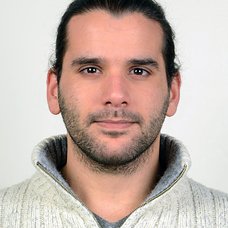
Georgios Maniatis
- Senior Lecturer, School of Applied Sciences
- Centre for Environment and Society
I am a fluvial geomorphologist and Senior Lecturer in Physical Geography at the University of Brighton. My research concerns the measurement, mapping and prediction of sediment transport in rivers, combining field observations, laboratory experiments, GIS and statistical modelling.
I work across three connected areas: instrumented grains and smart pebbles; advanced topographic sensing and geomorphic change detection; and hydromorphological assessment for river management and restoration. My current smart-pebble research uses inertial sensors, including the Kivi platform, to investigate grain motion and the uncertainty involved in inferring physical behaviour from sensor records. I am developing laboratory experiments that combine these measurements with optical observations, alongside an emerging interest in information theory and stochastic descriptions of sediment transport.
My background in environmental engineering, freshwater science and geomorphology includes research with Scottish Water and experience as a Senior Hydromorphologist at the Scottish Environment Protection Agency (SEPA).
Research interests
My research connects grain-scale sediment dynamics, reach-scale river adjustment and catchment-scale environmental management. I combine laboratory experiments, field observations, environmental sensing and statistical modelling, with an emphasis on measurement uncertainty and the links between physical processes across scales.
At the grain scale, I develop and evaluate smart pebbles and instrumented particles to investigate sediment motion, forces and energy. I am interested in how sensor records and optical observations can inform physical and stochastic descriptions of entrainment and transport. An emerging strand explores information theory to assess which measurements improve our understanding and prediction of grain behaviour.
At the reach scale, I use high-resolution topographic sensing, including photogrammetry and LiDAR, to investigate river morphology and geomorphic change. My interests include linking sediment dynamics with channel adjustment, comparing observations across spatial and temporal scales, and quantifying uncertainty in the detection and interpretation of change.
At the catchment scale, my interests include hydromorphological assessment, river restoration and the scoping of nature-based solutions. I examine how field evidence, geospatial analysis and process understanding can support environmental assessment and management decisions, including how assessment methods and observer judgement influence river classifications and intervention priorities.
Supervisory interests
I am interested in supervising postgraduate research students in the following areas: fluvial geomorphology; hydraulics; statistical and numerical modelling for sediment transport; river managment and engineering; development of sensors for monitoring grain motion.
Approach to teaching
Like every aspect of our lives, the teaching process needs to keep up with a historical transformation: we are moving from a world of lack of information to a world that there is too much of it. I teach fundamental geographical Techniques and several topics of surface Geomorphology. My approach is underlined by the requirement for 'upgrading' information to some type of knowledge. I like re-thinking fundamental concepts, presenting the science before the tools and engaging in real and open research discussions. There are ideas that take time to understand regardless how hard someone studies them. This is why context from real world problems and fieldwork should be a key part of teaching, especially for topics relating to applied disciplines like Physical Geography.
Academic qualifications
Academic Qualifications
- PhD, University of GlasgowProject: Geography and Computing Science
- Master, University of GlasgowProject: Freshwater Systems Science
- Bachelor, Technical University of CreteProject: 5y Diploma in Environmental Engineering
External positions
External Positions
- Honorary Research Associate, University of Glasgow