
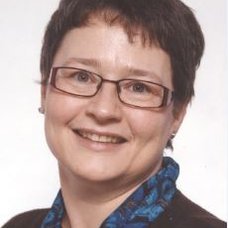
Friederike Gunzel
Dr
- Principal Lecturer, School of Arch, Tech and Eng
<p><span style="font-family: 'Arial',sans-serif; font-size: 12pt; mso-bidi-font-family: 'Times New Roman'; mso-bidi-font-size: 10.0pt; mso-fareast-font-family: Times; mso-ansi-language: EN-US; mso-fareast-language: EN-US; mso-bidi-language: AR-SA;"><span style="font-size: medium;">I studied Geology (5-year course) at the University of Munich from 1984-1989. After that, I continued my studies with a PhD in Geophysics from which I graduated in 1994. After working for consultancy companies, carrying out geophysical measurements, I was employed by the Geological Survey of Bavaria from 1997-1999. In 1999 I moved to Manchester, where I worked until 2000 as a research fellow with a geotechnical centrifuge. This post was followed by two more research posts at the Imperial College in London (2001) and the University of Dundee (2001-2006. In 2006 I was appointed Senior Lecturer at the University of Brighton. Here I have taught a range of subjects, such as concrete technology, mechanics of materials, soil mechanics, engineering geology and rock mechanics.</span></span></p>
Research interests
<p><span style="font-size: medium;"><strong>Permafrost:</strong> My main research interest is the rock slope stability in permafrost areas, such as high mountain ranges. The stability of a rock mass is mainly determined by joints in the rock. If these joints are frozen together, even vertical rock slopes can be very stable. However, as temperatures increase the ice in rock joints starts to become weaker and eventually it melts. This can lead to large rock falls that endanger infrastructure and may even cost lives. I measure the shear strength of ice filled rock joints in the lab to be able to predict the behavior of rock slopes in a warming climate.</span></p>
<p><span style="font-size: medium;"><strong>Roman concrete:</strong> Recently I developed a research interest in re-creating Roman concrete. This type of lime-based concrete is known to have extremely high durability with buildings still standing after 2000 years. Its production has a lower carbon footprint than the production of Portland Cement, which makes it interesting as a new building material. I experiment with different types of lime and different sources of silica, such as natural volcanic ash and pulverized fuel ash, to improve the strength of the material.</span></p>
Supervisory interests
<p><span style="font-size: medium;">Interests for new PhD supervision: </span></p>
<p><span style="font-size: medium;">One of my main interests is the s</span><span style="font-size: medium;">tability of rock slopes in permafrost regions: increasing temperatures have caused rock slope failures and rock falls in permafrost regions. The dependency on air temperature, ice thickness in the rock joints and the influence of meltwater will be investigated.</span></p>
<p><span style="font-size: medium;">Another interest is the shear strength of rock joints: laboratory measurement of direct shear stength of rock joints is difficult; a PhD project would use repeat measurements using artificial materials to proposed to improve existing models. </span></p>
<p><span style="font-size: medium;">Completed PhD supervision:</span></p>
<p><span style="font-size: medium;">Binyamien Rasoul (Start 2014, finish 2019): The effect of rice husk ash on the mechanical and durability properties of concrete.</span></p>
<p><span style="font-size: medium;">Peshawa Al-Jaf (Start 2014, finish 2019): Modelling flow and recharge in the Chalk unsaturated zone and influence of subsurface geologies, Brighton Block, South East England.</span></p>
Approach to teaching
<p><span style="font-size: medium;">I have come to civil engineering from a background in geology, which gives me a view of the subject from a different angle. I try to pass this on to the student to broaden their horizon and to prepare them for their careers where they will work with professionals from many different backgrounds.</span></p>
<p><span style="font-size: medium;">I always think it is extremely important for students to understand the basic principles of a subject and be then able to apply these principles to problems given to them. To achieve this I give students a hands-on approach with lab classes, field days and exercises. I also use specialised software for my teaching.</span></p>
<p><span style="font-size: medium;">During my classes I like to engage my students in discussions where they can apply the theory taught in class, explore different options and practice critical thinking.</span></p>
<p><span style="font-size: medium;">I expect my students to engage in the subject, read the background material (relevant chapters from the reading list) each week and attempt their exercises every week. I am always open for questions from students to make sure they receive all the support they need.</span></p>
<p><span style="font-size: medium;">I enjoy supervising final year projects, where I offer a wide range of topics, ranging from numerical analysis of tunnel and rock slope stability to recreating Roman concrete and plant fibre or bamboo reinforced concrete.</span></p>